
Never Risk More Than
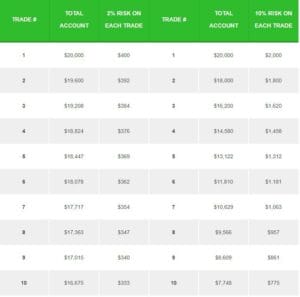

How much should you risk per trade?
Try to limit your risk to 2% per trade.
But that might even be a little high. Especially if you’re a newbie forex trader.
You can see that there is a big difference between risking 2% of your account compared to risking 10% of your account on a single trade!
If you happened to go through a losing streak and lost only 19 trades in a row, you would’ve gone from starting with $20,000 to having only $3,002 left if you risked 10% on each trade.
You would’ve lost over 85% of your account!
If you risked only 2% you would’ve still had $13,903 which is only a 30% loss of your total account.
Of course, the last thing we want to do is to lose 19 trades in a row, but even if you only lost 5 trades in a row, look at the difference between risking 2% and 10%.
- If you risked 2% you would still have $18,447.
- If you risked 10% you would only have $13,122.
That’s less than what you would’ve had even if you lost all 19 trades and risked only 2% of your account!
The point of this illustration is that you want to set up your risk management rules so that when you do have a drawdown period, you will still have enough capital to stay in the game.

Here is a table that will illustrate what percentage you would have to make to break even if you were to lose a certain percentage of your account.
You can see that the more you lose, the harder it is to make it back to your original account size.
This is all the more reason that you should do everything you can to PROTECT your account.
By now, we hope you have gotten it drilled into your head that you should only risk a small percentage of your account per trade so that you can survive your losing streaks and also avoid a large drawdown in your account.
Remember, you want to be the casino… NOT the gambler!
You can see that the more you lose, the harder it is to make it back to your original account size.
This is all the more reason that you should do everything you can to PROTECT your account.
By now, we hope you have gotten it drilled into your head that you should only risk a small percentage of your account per trade so that you can survive your losing streaks and also avoid a large drawdown in your account.
Remember, you want to be the casino… NOT the gambler!