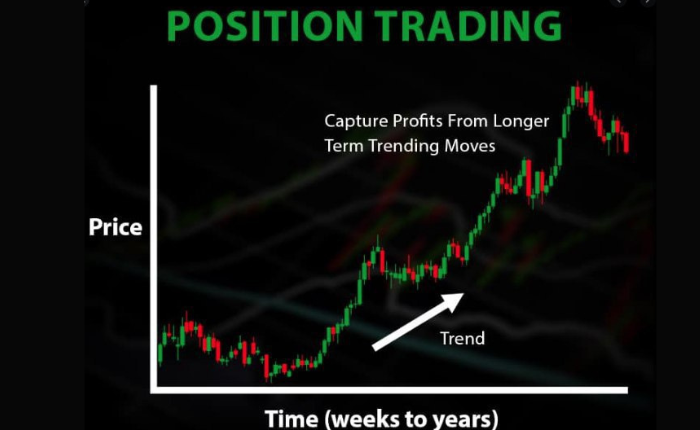
Position Trading
Position trading is the longest-term trading and can have trades that last for several months to several years!
Position traders ignore short-term price movements in favor of pinpointing and profiting from longer-term trends.
It is this type of trading that most closely resembles “investing”. The crucial difference is in markets outside forex, “investing” usually means you hold long positions.
This kind of forex trading is reserved for super PATIENT traders and requires a good understanding of the fundamentals.
Because position trading is held for so long, fundamental themes will be the predominant focus when analyzing the markets.
Fundamentals dictate the long-term trends of currency pairs and you must understand how economic data affects your country and its future outlook.
Because of the lengthy holding time of your trades, your stop losses will be very large.
This means that your losses can end up being huge, but it also means your profits can be Huge.
You must make sure you are well-capitalized or you will most likely get margin called.
For an idea of how much money you should have in your trading account, check out our money management lesson.
Position trading also requires thick skin because it is almost guaranteed that your trades will go against you at one point or another.
These won’t just be little retracements either.
You may experience huge swings and you must be ready and have absolute trust in your analysis in order to remain calm during these times.
Types of Position Trading
While fundamental analysis plays a much larger role for position traders, that doesn’t mean that technical analysis isn’t used.
Position traders tend to use both fundamental and technical analysis to evaluate potential trends.
Here are some trading strategies utilizing technical analysis that position traders use:
Trend Trading using Moving Averages (MA)
The 50-day moving average (MA) and 200-day moving average (MA) indicators a significant technical indicators for position traders.
The reason for this is due to the fact these moving averages illustrate significant long-term trends.
When the 50-day MA intersects with the 200-day MA, this signals the potential of a new long-term trend.
When the 50-day MA crosses below the 200-day MA, it is known as the “Death Cross“.
When the 50-day MA crosses above the 200-day MA, it is known as the “Golden Cross“.
These longer-term MAs are popular chart indicators for position traders.
Support and Resistance (S&R) Trading
Support and resistance levels can signal where the price is headed, letting position traders know whether to open or close a position.
A support level is a price level that, historically, does not fall below. These “historical” support levels can hold for years.
A resistance level is a price level that, historically, tends not to be able to break. These “historical” resistance levels can also hold for years.
If position traders expect a long-term resistance hold, they can close out their positions before unrealized profits start melting away.
They may also enter long positions at historical support levels if they expect a long-term trend to hold and continue upward at this point.
This strategy requires traders to analyze chart patterns. When analyzing the chart, position traders consider three factors when trying to identify support and resistance levels.
The historic price is the most reliable source when identifying support and resistance. During periods of significant up or down in a market, recurring support and resistance levels are easy to spot.
Previous support and resistance levels can indicate future levels. It is not unusual for a resistance level to become a future support level once it has been broken.
Technical indicators like moving averages and Fibonacci retracement provide dynamic support and resistance levels that move as the price moves.
Breakout Trading
Trading breakouts can be useful for position traders as they can signal the start of a new trend.
Breakout traders using this technique are attempting to open a position in the early stages of a trend.
A breakout is where the price moves outside defined support or resistance levels (preferably confirmed with increased volume).
The idea behind trading breakouts is to open a long position after the price breaks above resistance or open a short position when the price breaks below support.
To successfully trade breakouts, you will need to be confident in identifying periods of support and resistance.
Pullback Trading
A pullback is a short dip or slight reversal in the prevailing trend.
This strategy is used when there is a brief market dip in a longer-term trend.
Pullback traders aim to capitalize on these pauses in the market.
The idea behind the pullback strategy is this:
For long trades, buy low and sell high before a market briefly dips, and then buy again at the new low.
For short trades, to sell high and buy low before a market briefly rallies, and then sell again at the new high.
If executed successfully, a trader can not only profit from a long-term trend but avoid possible market losses by:
Selling high and buying the dips (for long trades).
Buying low and selling the rips (for short trades).
To help identify potential pullbacks, you can use retracement indicators, like the Fibonacci retracement.
You might be a position trader if:
- You are an independent thinker. You have to be able to ignore popular opinion and make your educated guesses as to where the market is going.
- You have a great understanding of fundamentals and have good foresight into how they affect your currency pair in the long run.
- You have thick skin and can weather any retracements you face.
- You have enough capital to withstand several hundred pips if the market goes against you.
- You don’t mind waiting for your grand reward. Long-term forex trading can net you several hundred to several thousands of pips. If you get excited being up 50 pips and already want to exit your trade, consider moving to a shorter-term trading style.
- You are extremely patient and calm.
You might NOT be a position trader if:
- You easily get swayed by popular opinions on the markets.
- You don’t have a good understanding of how fundamentals affect the markets in the long run.
- You aren’t patient. Even if you are somewhat patient, this still might not be the trading style for you. You have to be the ultimate zen master when it comes to being this kind of patient!
- You don’t have enough starting capital.
- You don’t like it when the market goes against you.
- You like seeing your results fast. You may not mind waiting a few days, but several months or even years is just too long for you to wait.