
Monetary Policy
National governments and corresponding central banking authorities formulate monetary policy to achieve specific economic mandates or goals.
Central banks and monetary policy go hand-in-hand, so you can’t talk about one without talking about the other.
While some of these mandates and goals are very similar between the world’s central banks, each has its unique set of goals brought on by their distinctive economies.
Ultimately, monetary policy promotes and maintains price stability and economic growth.
To achieve their goals, central banks use monetary policy mainly to control the following:
- The interest rates are tied to the cost of money,
- The rise in inflation,
- The money supply,
- Reserve requirements over banks (the portion of depositors’ balances that commercial banks must have as cash) and lending to commercial banks (via the discount window).
Types of Monetary Policy
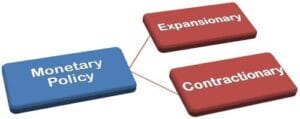
Monetary policy can be referred to in a couple of different ways. Contractionary or restrictive monetary policy takes place if it reduces the size of the money supply. It can also occur with the raising of interest rates. The idea here is to slow economic growth with high interest rates. Borrowing money becomes harder and more expensive, reducing spending and investment by consumers and businesses.
On the other hand, expansionary monetary policy expands or increases the money supply or decreases the interest rate. The cost of borrowing money goes down in hopes that spending and investment will increase.
Accommodative monetary policy aims to create economic growth by lowering the interest rate, whereas tight monetary policy is set to reduce inflation or restrain economic growth by raising interest rates.
Finally, a neutral monetary policy intends to neither create growth nor fight inflation.

Important to remember about inflation is that central banks usually have an inflation target in mind, say 2%. They might not say it specifically, but their monetary policies all operate and focus on reaching this comfort zone. They know that some inflation is good, but out-of-control inflation can remove people’s confidence in their economy, jobs, and, ultimately, their money. By having target inflation levels, central banks help market participants better understand how they (the central bankers) will deal with the current economic landscape.