
Rules of the Elliott Wave Theory
Rule Number #1: Wave 3 can NEVER be the shortest impulse wave.
Rule Number #2: Wave 2 can NEVER go beyond the start of Wave 1.
Rule Number #3: Wave 4 can NEVER cross in the same price area as Wave 1
Using the Elliot Wave Theory

Using your knowledge of Elliott Wave, you label this move up as Wave 1 and the retracement as Wave 2. To find a good entry point, head back to the School of Pipsology to find out which of the three cardinal rules and guidelines you could apply. Here’s what you found out: Rule Number #2: Wave 2 can NEVER go beyond the start of Wave 1. Waves 2 and 4 frequently bounce off Fibonacci retracement levels.
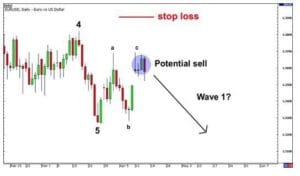
You begin counting the waves on a downtrend and notice that the ABC corrective waves move sideways. Hmm, is this a flat formation in the works? The price may begin a new impulse wave once Wave C ends. Trusting your Elliott Wave skills, you sell at the market price to catch a new impulse wave. You place your stop just a couple of pips above the start of Wave 4 just in case your wave count is wrong.