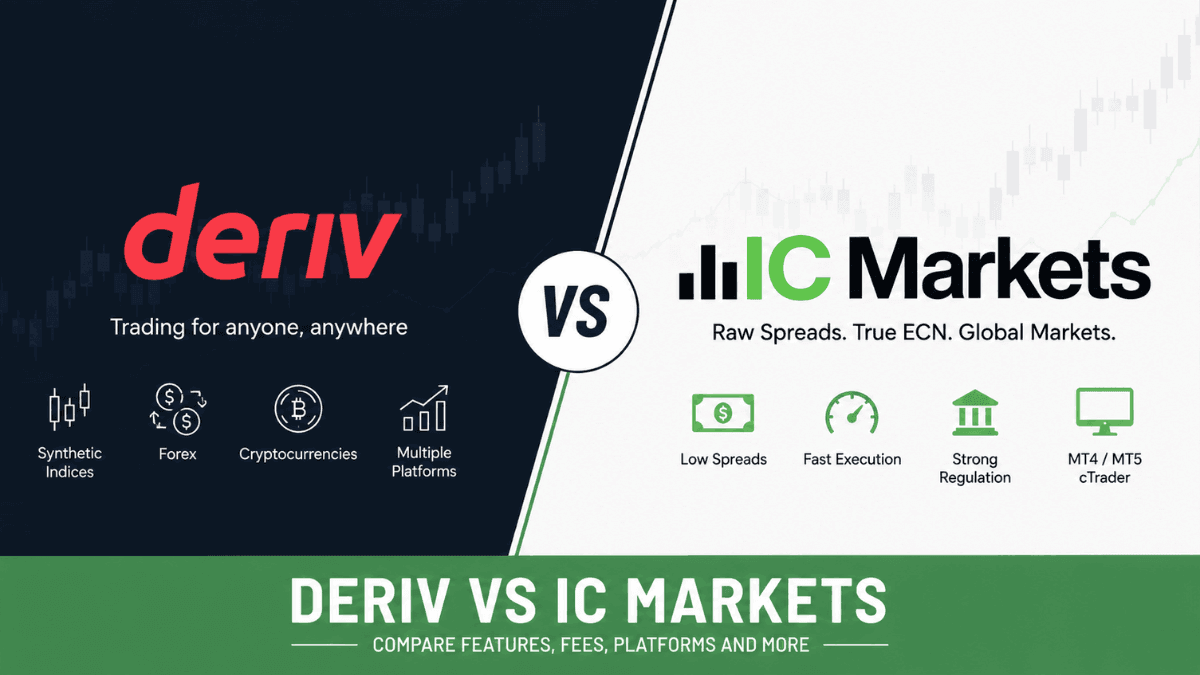
When comparing Deriv vs IC Markets, traders often discover that these brokers serve different types of clients despite both offering access to global financial markets. Deriv has built its reputation around synthetic indices, flexible account options, and beginner-friendly trading tools, while IC Markets is widely recognized for its institutional-grade pricing, deep liquidity, and strong appeal among forex traders.
The right choice depends on your trading goals. Are you looking for ultra-tight spreads and advanced trading infrastructure? Or do you prefer access to unique products such as synthetic indices and simplified account management? This detailed comparison examines every major aspect of both brokers to help you make an informed decision.

Overview of Deriv and IC Markets
Before diving into the details, it helps to understand what makes each broker unique.
Deriv at a Glance
Deriv traces its roots back to 1999 when it operated under the Binary.com brand. Over the years, it expanded its product lineup and rebranded as Deriv while maintaining a strong presence in multiple regions worldwide.
Key features include:
- Forex trading
- Synthetic indices
- Commodities
- Cryptocurrencies
- Stock CFDs
- Proprietary trading platforms
- MT5 support
Deriv is especially popular among traders seeking markets that operate 24/7, including synthetic indices that are not affected by real-world economic events.
IC Markets at a Glance
IC Markets was founded in 2007 and has become one of the largest forex and CFD brokers globally. The broker focuses heavily on providing institutional-grade trading conditions to retail traders.
Key features include:
- Raw spread accounts
- Deep liquidity pools
- Forex and CFD trading
- MetaTrader 4
- MetaTrader 5
- cTrader
- High-speed execution
IC Markets is frequently chosen by scalpers, day traders, and algorithmic traders who prioritize low trading costs.
Deriv vs IC Markets Regulation and Safety
Regulation is one of the most important factors when choosing a broker because it directly affects client fund protection and operational transparency.
Deriv Regulation
Deriv operates through several entities regulated in different jurisdictions, including:
- Malta Financial Services Authority
- Labuan Financial Services Authority
- British Virgin Islands Financial Services Commission
Client protection standards vary depending on the entity under which an account is opened.
IC Markets Regulation
IC Markets operates through multiple regulated entities, including oversight from:
- Australian Securities and Investments Commission
- Cyprus Securities and Exchange Commission
- Financial Services Authority Seychelles
For traders who prioritize top-tier regulatory oversight, IC Markets generally has a stronger regulatory reputation due to its long-standing association with ASIC and CySEC.
Safety Verdict
Both brokers are legitimate and regulated. However, IC Markets holds a slight advantage because of its stronger reputation among professional traders and its presence under highly respected regulatory frameworks.
Trading Instruments Comparison
Market selection can significantly influence your trading opportunities.
What You Can Trade with Deriv
Deriv offers a diverse product range that includes:
- Forex pairs
- Commodities
- Cryptocurrencies
- Stock CFDs
- ETFs
- Synthetic indices
The synthetic indices category is where Deriv stands apart. These markets simulate real market behavior using cryptographically secure random number generation and operate around the clock.
What You Can Trade with IC Markets
IC Markets focuses heavily on traditional financial markets, including:
- Forex
- Indices
- Commodities
- Stocks
- Bonds
- Futures CFDs
- Cryptocurrencies
Forex traders benefit from access to dozens of currency pairs with highly competitive pricing.
Instrument Winner
If synthetic indices are important to you, Deriv is the obvious choice.
If your focus is forex, commodities, stock CFDs, and institutional-style trading, IC Markets offers a broader professional trading environment.
Deriv vs IC Markets Trading Platforms
Trading platforms determine how efficiently you analyze markets and execute trades.
Deriv Platforms
Deriv provides several proprietary platforms:
Deriv MT5
This platform supports forex, CFDs, and synthetic indices while offering advanced charting capabilities.
Deriv Trader
Designed for simplicity, Deriv Trader allows users to access various markets through a web-based interface.
Deriv X
Deriv X offers advanced charting, multiple workspaces, and customizable layouts.
Deriv cTrader
In some regions, traders can also access cTrader functionality through Deriv’s ecosystem.
IC Markets Platforms
IC Markets supports some of the most respected platforms in the industry.
MetaTrader 4
MT4 remains a favorite among forex traders due to its reliability and extensive Expert Advisor (EA) support.
MetaTrader 5
MT5 expands on MT4 with additional timeframes, improved order management, and broader market coverage.
cTrader
cTrader is particularly popular among advanced traders because of its intuitive interface and sophisticated execution tools.
Platform Winner
IC Markets takes the lead for platform variety and professional-grade trading tools.
Spreads, Commissions, and Trading Costs
Trading costs directly impact long-term profitability, particularly for active traders.
Deriv Pricing
Deriv generally incorporates costs into spreads for many account types.
Typical characteristics include:
- Competitive spreads
- No hidden fees
- Flexible account structures
The exact costs vary depending on the asset class and account type.
IC Markets Pricing
IC Markets is widely known for its low-cost trading environment.
The Raw Spread Account typically offers:
- Spreads starting from 0.0 pips
- Fixed commission per lot
- Institutional liquidity access
This structure is highly attractive to scalpers and high-frequency traders.
Cost Winner
For active forex traders, IC Markets usually delivers lower overall trading costs.
For casual traders who prefer simplicity, Deriv’s pricing structure may be easier to understand.
Account Types Comparison
Different account types cater to different trading styles.
Deriv Accounts
Deriv offers:
- Standard Accounts
- Financial Accounts
- Synthetic Accounts
- Swap-Free Options
The availability of synthetic accounts creates opportunities unavailable at most traditional brokers.
IC Markets Accounts
IC Markets provides:
Standard Account
Commission-free trading with spreads included in pricing.
Raw Spread Account
Ultra-low spreads with a commission-based structure.
cTrader Account
Designed specifically for traders using the cTrader platform.
Account Winner
IC Markets provides more professional account structures, while Deriv offers greater product flexibility.
Execution Speed and Trading Conditions
Execution quality can make a significant difference during volatile market conditions.
Deriv Execution
Deriv offers stable execution across its proprietary ecosystem. Most retail traders experience smooth order processing, especially when trading synthetic indices.
IC Markets Execution
IC Markets has built its reputation on execution speed.
Benefits include:
- Low latency
- Deep liquidity
- Minimal requotes
- Scalping support
- Algorithmic trading compatibility
Execution Winner
IC Markets is the stronger choice for traders who rely on fast execution and precision entries.
Deposit and Withdrawal Methods
Funding flexibility matters, particularly for traders in regions where traditional banking options are limited.
Deriv Payments
Deriv supports:
- Bank transfers
- Credit cards
- E-wallets
- Cryptocurrencies
- Regional payment solutions
Many African traders appreciate the wide variety of localized payment methods.
IC Markets Payments
IC Markets supports:
- Bank transfers
- Credit cards
- Skrill
- Neteller
- PayPal
- Various regional methods
Processing times are generally competitive.
Payments Winner
Deriv often offers greater flexibility, especially for traders in emerging markets.
Educational Resources and Research
Education can help traders improve decision-making and risk management.
Deriv Education
Deriv provides:
- Trading guides
- Tutorials
- Market insights
- Platform education
The content is particularly useful for beginners.
IC Markets Education
IC Markets offers:
- Trading webinars
- Market analysis
- Economic commentary
- Educational articles
- Video tutorials
The research quality tends to be more comprehensive.
Education Winner
IC Markets has a stronger overall educational and research offering.
Customer Support Comparison
Reliable support becomes crucial when dealing with account or trading issues.
Deriv Support
Deriv provides:
- Live chat
- Help center
- Email support
Response times are generally satisfactory.
IC Markets Support
IC Markets offers:
- 24/7 support
- Live chat
- Email support
- Extensive knowledge base
The broker is widely recognized for responsive customer service.
Support Winner
IC Markets gains a slight advantage due to its strong industry reputation for support quality.
Which Broker Is Better for Beginners?
Choosing your first broker can feel overwhelming, but the answer often depends on what you plan to trade.
Deriv may be better if:
- You want to trade synthetic indices.
- You prefer simple account management.
- You need flexible deposit methods.
- You are interested in 24/7 market availability.
IC Markets may be better if:
- You want to focus on forex trading.
- You plan to use Expert Advisors.
- You need ultra-low spreads.
- You are interested in professional trading tools.
Deriv vs IC Markets: Pros and Cons
Deriv Pros
- Unique synthetic indices
- Multiple proprietary platforms
- Flexible payment methods
- Beginner-friendly environment
- Strong global presence
Deriv Cons
- Fewer institutional trading features
- Research tools are less comprehensive
- Traditional market selection is smaller
IC Markets Pros
- Extremely low spreads
- Fast execution
- Strong regulatory reputation
- Excellent platform selection
- Ideal for algorithmic trading
IC Markets Cons
- Fewer unique products
- Raw accounts include commissions
- Can feel complex for complete beginners
Final Verdict
The Deriv vs IC Markets comparison highlights two brokers designed for different audiences.
Deriv stands out because of its synthetic indices, flexible payment options, and beginner-friendly ecosystem. Traders who want access to unique markets unavailable elsewhere often find Deriv particularly appealing.
IC Markets excels in areas that matter most to serious forex traders: tight spreads, deep liquidity, professional platforms, and fast execution. If your primary goal is trading forex or CFDs under institutional-style conditions, IC Markets is generally the stronger choice.
For most active forex traders, IC Markets earns the overall win. For traders focused on synthetic indices and simplified access to global markets, Deriv remains one of the most compelling alternatives available.
Frequently Asked Questions
Neither broker is universally better. Deriv excels in synthetic indices and payment flexibility, while IC Markets is stronger for forex trading, spreads, and execution quality.
Yes. Although it caters to professional traders, beginners can still benefit from its educational resources and Standard Account option.
No. Synthetic indices are a specialty product offered by Deriv and are not available on IC Markets.
IC Markets generally offers lower forex spreads, particularly on its Raw Spread Account.
Yes. Deriv operates through several regulated entities across different jurisdictions.
Yes. IC Markets supports automated trading through MT4, MT5, and cTrader, making it a popular choice among algorithmic traders.
Both brokers are popular across Africa. Deriv often attracts traders seeking flexible funding options and synthetic indices, while IC Markets appeals to forex traders looking for lower costs and professional trading conditions.
Trade Anytime, Anywhere with XM
Take your trading to the next level with a globally trusted forex and CFD broker. Enjoy competitive spreads, fast execution, and reliable customer support while trading securely.
With XM, you get access to powerful trading platforms, real-time charts, flexible account types, and advanced tools to help you analyze the markets and manage your trades efficiently. Start your journey today by opening a trading account for free and join millions of traders worldwide.
✅ Open an Account with XM
Our Editorial Desk – Focuses on forex trading, gold (XAU/USD), and commodities that move the markets. Our editorial desk blends human insight with AI-powered research to produce sharp, actionable content. We aim to help traders make informed decisions with unbiased market coverage.