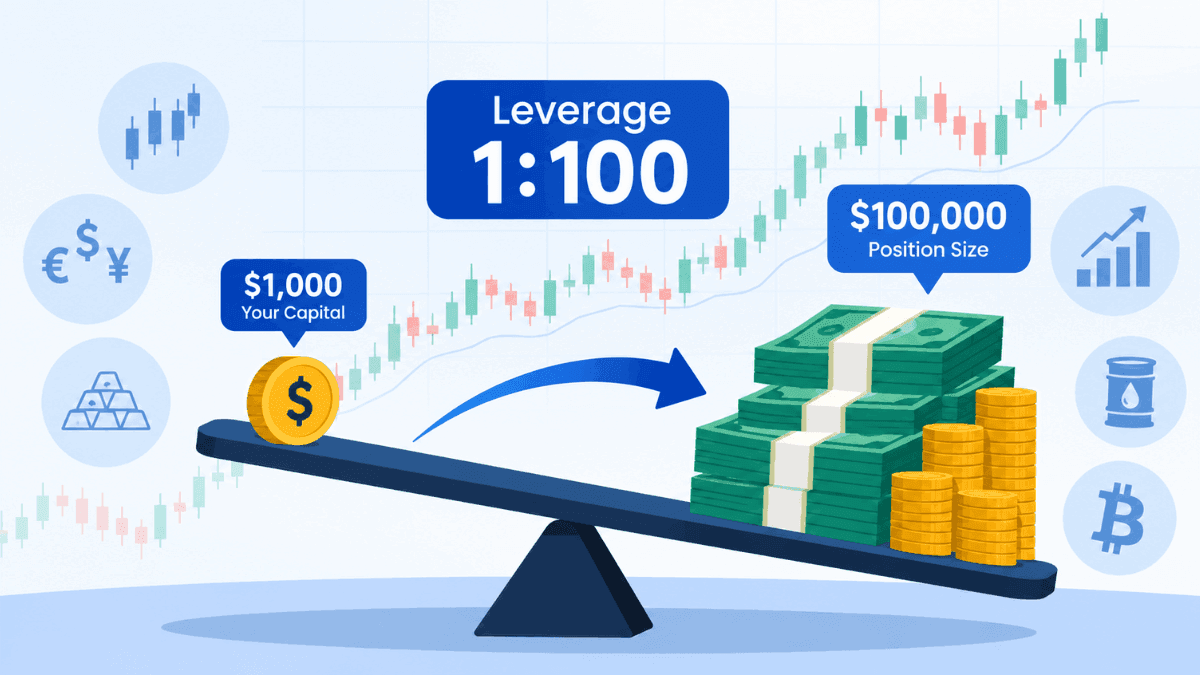
Leverage is one of the most powerful tools available to traders, but it’s also one of the most misunderstood. Used correctly, leverage allows you to control larger market positions with a relatively small amount of capital. Used carelessly, it can magnify losses just as quickly as it increases potential profits.
Whether you’re trading forex, stocks, indices, commodities, or cryptocurrencies, understanding leverage is essential before placing your first trade. Many beginners are attracted by the possibility of earning bigger returns without fully appreciating the risks involved. Experienced traders, on the other hand, often view leverage as a risk management tool rather than a way to gamble with larger positions.

This guide explains what leverage is, how it works, why brokers offer it, its advantages and disadvantages, and practical ways to use it responsibly.
What Is Leverage?
Leverage is a financial mechanism that allows traders to control a larger trading position using a smaller amount of their own money.
Think of leverage as borrowing purchasing power from your broker. Instead of paying the full value of a trade, you only need to deposit a fraction of its value, known as margin. The broker effectively provides the rest, enabling you to access larger market exposure.
For example, if your broker offers 1:100 leverage, every $1 in your account allows you to control up to $100 in the market.
This doesn’t mean the broker is giving you free money. It simply means your gains and losses are calculated based on the full trade size—not just the amount you deposited.
How Does Leverage Work?
Understanding leverage becomes much easier when you look at a simple example.
Imagine you have $500 in your trading account.
Without leverage, you could only open trades worth approximately $500.
With 1:100 leverage, your buying power increases to:
$500 × 100 = $50,000
Although you’ve only invested $500, your profits and losses are based on the $50,000 position.
Suppose the market moves:
- Up by 1% → Profit = $500
- Down by 1% → Loss = $500
A relatively small market movement can therefore double your account—or wipe it out—depending on the direction of your trade.
This illustrates why leverage is often described as a double-edged sword.
Understanding Leverage Ratios
Leverage is usually expressed as a ratio.
Here are some common leverage levels:
| Leverage Ratio | Buying Power |
|---|---|
| 1:2 | $2 for every $1 deposited |
| 1:5 | $5 for every $1 deposited |
| 1:10 | $10 for every $1 deposited |
| 1:30 | $30 for every $1 deposited |
| 1:50 | $50 for every $1 deposited |
| 1:100 | $100 for every $1 deposited |
| 1:200 | $200 for every $1 deposited |
| 1:500 | $500 for every $1 deposited |
Higher leverage increases both potential returns and potential losses.
Many regulated brokers limit maximum leverage for retail traders to reduce excessive risk, while some offshore brokers advertise extremely high leverage, such as 1:1000 or even higher.
Leverage vs Margin
Many traders confuse leverage with margin because the two concepts are closely connected.
Leverage refers to how much larger a position you can control compared to your own capital.
Margin is the amount of money required to open and maintain that leveraged position.
For example:
- Trade size = $100,000
- Leverage = 1:100
- Required margin = 1%
In this case, you only need:
$100,000 × 1% = $1,000
The $1,000 serves as collateral while the position remains open.
Why Do Brokers Offer Leverage?
Brokers provide leverage because it increases trading activity and makes financial markets more accessible.
Without leverage, many retail traders wouldn’t have enough capital to participate meaningfully in markets such as forex, where standard trading sizes are relatively large.
Leverage allows traders to:
- Access larger positions
- Trade with smaller accounts
- Diversify across multiple positions
- Improve capital efficiency
Brokers also earn through spreads, commissions, or financing charges, making leveraged trading beneficial for their business model.
Advantages of Using Leverage
Leverage isn’t inherently dangerous. When combined with sound risk management, it can become a valuable trading tool.
Increased Market Exposure
Leverage enables traders to participate in larger market opportunities without needing substantial capital.
This makes trading accessible to individuals who are building smaller accounts.
Better Capital Efficiency
Instead of committing your entire account to one position, leverage allows you to keep part of your capital available for other opportunities.
Professional traders often prefer this flexibility because it supports portfolio diversification.
Potential for Higher Returns
Since profits are calculated based on the full position size, successful trades can generate significantly higher percentage returns.
This is one reason leverage is widely used in forex trading, where daily price movements are often relatively small.
More Trading Opportunities
Using leverage can allow you to trade multiple instruments simultaneously rather than tying all your capital to a single market.
This flexibility can improve overall portfolio management when done carefully.
Risks of Leverage
While leverage offers attractive opportunities, it also introduces substantial risk.
Understanding these dangers is essential before increasing your position size.
Losses Are Magnified
Just as leverage amplifies profits, it magnifies losses.
A small market movement against your trade can result in significant account losses.
Margin Calls
If your account equity falls below the broker’s required maintenance level, you may receive a margin call.
This means you’ll need to deposit additional funds or reduce your positions to avoid automatic liquidation.
Stop-Out Levels
Many brokers automatically close losing positions if account equity drops below a predetermined threshold.
This process is called a stop-out, and it helps prevent your account balance from becoming negative.
Emotional Pressure
Trading oversized leveraged positions often increases emotional stress.

Fear and greed can lead traders to abandon their strategy, move stop-loss orders, or make impulsive decisions.
A Practical Example of Leverage
Let’s compare two scenarios.
Scenario A: No Leverage
- Account balance: $1,000
- Trade size: $1,000
- Market moves +2%
- Profit: $20
Scenario B: 1:100 Leverage
- Account balance: $1,000
- Trade size: $100,000
- Market moves +2%
- Profit: $2,000
The second scenario appears much more attractive.
Now imagine the market falls by 2% instead.
The trader would lose $2,000—twice the size of their account—although most brokers would automatically close the position before losses reached that level.
This example demonstrates why position sizing matters even more than leverage itself.
Does Higher Leverage Mean Higher Risk?
Not necessarily.
A common misconception is that choosing higher leverage automatically makes trading riskier.
The real determinant of risk is position size.
For example:
- Trader A uses 1:500 leverage but risks only 1% of their account.
- Trader B uses 1:20 leverage but risks 25% of their account.
Trader B is taking significantly more risk despite using lower leverage.
Experienced traders often select higher leverage simply because it reduces the margin required to open trades—not because they intend to risk more money.
How Professional Traders Use Leverage
Professional traders rarely use the maximum leverage available.
Instead, they combine leverage with strict money management rules.
Common practices include:
- Risking only 1–2% of account equity per trade
- Always using stop-loss orders
- Calculating position size before entering a trade
- Avoiding excessive exposure across correlated markets
- Increasing position size only after consistent profitability
Their objective is consistency rather than chasing exceptionally large returns.
Choosing the Right Leverage
There is no universal “best” leverage because it depends on your trading style, experience, and risk tolerance.
A conservative swing trader holding positions for several days may prefer relatively low leverage because overnight price movements can be unpredictable.
A day trader who exits positions within hours may use moderately higher leverage while still maintaining disciplined risk management.
Beginners should generally start with lower leverage until they gain confidence in managing position sizes, stop losses, and market volatility.
Best Practices for Using Leverage Safely
Successful traders don’t avoid leverage—they control it carefully.
Consider these practical guidelines:
- Never risk money you cannot afford to lose.
- Always calculate position size before entering a trade.
- Place a stop-loss on every trade.
- Avoid using maximum available leverage simply because it’s offered.
- Monitor your margin level regularly.
- Diversify your exposure instead of concentrating risk in one trade.
- Focus on preserving capital before maximizing returns.
- Practice with a demo account before trading leveraged positions with real money.
These habits help reduce unnecessary risk while allowing you to benefit from leverage when appropriate.
Common Mistakes Beginners Make
Many new traders misunderstand how leverage works, leading to avoidable losses.
Some of the most common mistakes include:
- Opening positions that are too large for their account size.
- Confusing available margin with money they can safely risk.
- Ignoring stop-loss orders.
- Chasing losses by increasing leverage after losing trades.
- Believing high leverage guarantees faster profits.
- Trading highly volatile markets without adjusting position size.
Avoiding these mistakes can dramatically improve your long-term survival as a trader.
Frequently Asked Questions About Leverage
Is leverage good or bad?
Leverage is neither good nor bad on its own. It is simply a financial tool. The outcome depends on how responsibly it is used.
What is the safest leverage for beginners?
Many beginners start with relatively low leverage while learning proper risk management. More important than the leverage ratio is limiting the percentage of your account risked on each trade.
Can you lose more than your deposit?
With some brokers and in certain market conditions, it may be possible to lose more than your deposit. However, many regulated brokers provide negative balance protection, which prevents retail clients from owing additional money after extreme market moves.
Is leverage only used in forex trading?
No. Leverage is widely available across forex, stocks, commodities, exchange-traded funds (ETFs), indices, futures, options, and cryptocurrency markets.
Should I always use the highest leverage available?
No. High leverage increases flexibility by reducing margin requirements, but it should not be used as a reason to open larger positions than your trading plan allows.
Final Thoughts
Leverage is one of the defining features of modern trading because it allows investors to control positions much larger than their account balance would normally permit. That increased buying power creates opportunities, but it also increases responsibility.
The key lesson is that leverage itself is not the enemy. Poor risk management is. Traders who understand position sizing, use stop-loss orders, and manage risk consistently can benefit from leverage without exposing their accounts to unnecessary danger.
If you’re just starting, focus on mastering risk management before increasing your leverage. Building disciplined habits early is far more valuable than chasing oversized profits, and it’s one of the most reliable ways to stay in the markets for the long term.
Trade Anytime, Anywhere with XM
Take your trading to the next level with a globally trusted forex and CFD broker. Enjoy competitive spreads, fast execution, and reliable customer support while trading securely.
With XM, you get access to powerful trading platforms, real-time charts, flexible account types, and advanced tools to help you analyze the markets and manage your trades efficiently. Start your journey today by opening a trading account for free and join millions of traders worldwide.
✅ Open an Account with XM
Our Editorial Desk – Focuses on forex trading, gold (XAU/USD), and commodities that move the markets. Our editorial desk blends human insight with AI-powered research to produce sharp, actionable content. We aim to help traders make informed decisions with unbiased market coverage.