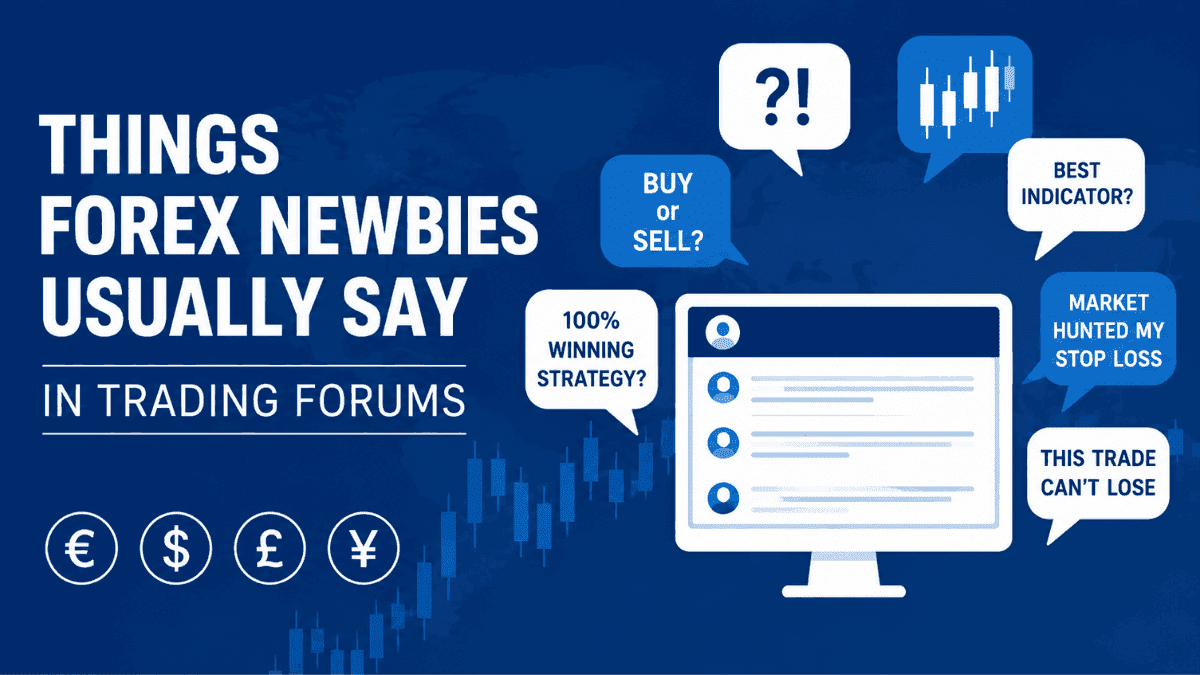
Trading forums can be an incredible place to learn. They’re full of traders sharing charts, discussing strategies, celebrating wins, and debating market direction. They’re also where beginners often reveal the mindset that’s holding them back.
Things forex newbies usually say in trading forums often sound harmless at first. Yet these comments expose common misunderstandings about risk, probabilities, trading psychology, and how the foreign exchange market actually works. Experienced traders can often tell whether someone is likely to succeed—not by the strategy they discuss, but by the questions they ask and the statements they repeatedly make.

If you’ve ever caught yourself saying some of these things, don’t worry. Nearly every successful trader started with similar beliefs. The difference is that profitable traders eventually replaced myths with sound principles.
Let’s look at the most common statements new forex traders make and what they should be thinking instead.
Why Trading Forums Reveal a Trader’s Mindset
Every trader brings assumptions into the market. Trading forums simply make those assumptions visible.
The questions people ask, the complaints they make, and the advice they seek often reveal whether they’re focused on making money quickly or building long-term trading skills. One mindset usually leads to frustration. The other creates steady improvement.
The good news is that changing how you think is entirely possible. It starts with recognizing the patterns.
1. “What’s the Best Indicator?”
Many beginners spend weeks searching for the perfect indicator that never gives false signals.
The reality is that no indicator predicts the future. Indicators simply process historical price data in different ways. Moving averages, Relative Strength Index (RSI), and the Moving Average Convergence Divergence (MACD) all describe price—they don’t guarantee where it will go next.
Professional traders don’t ask which indicator is best.
They ask:
- What market condition am I trading?
- Does this tool help me make better decisions?
- Does my strategy have a statistical edge?
The indicator matters far less than how consistently it’s used within a tested trading plan.
2. “Can Someone Give Me a 100% Winning Strategy?”
This is probably the most common beginner question across every trading community.
The uncomfortable truth is that such a strategy doesn’t exist.
Every professional trader accepts losses as part of the business. Trading is based on probabilities, not certainty. Even strategies with excellent long-term performance can experience losing streaks.
Instead of searching for perfection, experienced traders focus on questions like:
- Does this strategy produce positive results over hundreds of trades?
- Can I execute it consistently?
- Is my risk controlled?
Consistency beats perfection every time.
Things Forex Newbies Usually Say in Trading Forums About Losses
How traders talk about losing trades often reveals whether they’re learning or simply gambling.
Losses aren’t automatically mistakes. A perfectly executed trade can still lose because markets are unpredictable in the short term.
3. “The Market Hunted My Stop Loss”
Many beginners believe brokers or “the market” intentionally target their stop losses.
While large institutions can influence price through liquidity, individual retail traders are generally far too small to be singled out.
More often than not, stop losses get hit because they’re placed:
- Too close to normal price fluctuations
- At obvious support or resistance levels
- Without considering market volatility
Instead of blaming manipulation, ask whether your stop placement makes technical sense.
4. “I Just Need to Recover My Loss”
This statement usually appears after a trader has experienced several losing trades.
The desire to immediately win back losses is understandable, but it’s also dangerous. It often leads to revenge trading—making impulsive trades driven by emotion rather than analysis.
Professional traders think differently.
They focus on protecting capital first. They know another opportunity will always come, but lost capital can take much longer to rebuild.
5. “This Trade Can’t Lose”
Confidence is valuable. Certainty is expensive.
Markets regularly surprise even the most experienced analysts. Unexpected economic announcements, geopolitical events, or changes in market sentiment can reverse seemingly perfect setups.
Good traders never assume a trade is guaranteed.
Instead, they prepare for both possible outcomes before entering the position.
6. “I Doubled My Account This Week”
Trading forums often become highlight reels.
Someone posts enormous gains while rarely mentioning the equally enormous risks taken to achieve them. Beginners naturally become excited and assume that’s normal.
In reality, rapid account growth usually comes with excessive leverage, oversized positions, or poor risk management.
Sustainable trading looks much less exciting.
Professional traders often celebrate consistency rather than spectacular profits.
7. “Should I Buy or Sell Right Now?”
This question seems innocent, but it highlights a deeper problem.
Many beginners rely on strangers to make trading decisions instead of learning market analysis themselves.
Even if someone gives you the correct answer today, it won’t help tomorrow when the market changes.
Learning how to evaluate:
- Market structure
- Support and resistance
- Trend direction
- Risk-to-reward ratio
- Economic news
will always provide more value than copying random trade ideas.
Why Experienced Traders Rarely Give Direct Trade Signals
Successful traders understand that every trader has different goals, account sizes, and risk tolerance.
A trade that’s appropriate for one person may be completely unsuitable for someone else.
That’s why experienced traders usually explain why they entered a trade instead of simply saying “buy now.”
Understanding the reasoning matters far more than copying the position.
8. “How Much Can I Make Every Day?”
This question comes from thinking of trading as a salary.
Markets don’t produce opportunities on demand. Some days present excellent setups. Other days offer nothing worth trading.
Professional traders don’t chase daily income targets.
Instead, they focus on executing high-quality trades whenever their strategy provides an edge.
Ironically, trying to force daily profits often creates unnecessary losses.
9. “I Don’t Need a Stop Loss”
Nearly every experienced trader has heard this statement before.
Sometimes it comes from overconfidence. Other times it’s based on the belief that price will eventually return.
Unfortunately, markets can remain irrational far longer than traders expect.
Without predefined risk limits, one bad trade can erase months of careful progress.
Stop losses aren’t signs of weakness.
They’re insurance policies for your trading account.
10. “My Strategy Stopped Working”
Many beginners abandon strategies after only a handful of losing trades.
Every legitimate trading system experiences drawdowns—a temporary decline in performance.
Experienced traders understand the difference between:
- Normal statistical variation
- A strategy that’s genuinely broken
This distinction only becomes clear through proper backtesting and detailed trading records.
11. “The News Always Ruins My Trades”
Economic news can create sudden volatility.
Interest rate announcements, inflation reports, employment figures, and central bank speeches frequently move currency prices dramatically.
Rather than blaming the news, experienced traders plan for it.
Some avoid trading during major announcements. Others build news volatility into their strategies.
Preparation always beats surprise.
12. “I Found the Holy Grail”
Every few months, trading forums become excited about a brand-new strategy that supposedly never loses.
The excitement rarely lasts.
Markets constantly evolve because they’re driven by millions of participants making independent decisions. No strategy remains perfect forever.
Professional traders understand that success comes from adaptation, disciplined execution, and effective risk management—not secret indicators.
The Statements Experienced Traders Say Instead
Over time, successful traders begin speaking very differently.
Their conversations focus less on profits and more on process.
You’ll often hear statements like:
- “My edge worked over my last 200 trades.”
- “I followed my trading plan.”
- “My risk was controlled.”
- “The setup didn’t meet my criteria, so I stayed out.”
- “I’ll review this trade in my journal.”
- “One trade doesn’t define my performance.”
- “Capital preservation comes first.”
Notice how little emphasis there is on predicting markets.
The focus shifts toward consistency and discipline.
How to Get Real Value From Trading Forums
Trading forums aren’t inherently good or bad. Their value depends on how you use them.
Forums become valuable when you:
- Learn different analytical perspectives.
- Share charts for constructive feedback.
- Discuss trading psychology.
- Exchange educational resources.
- Ask thoughtful questions.
- Challenge your own assumptions.
They become harmful when you constantly chase signals, compare profits, or believe every bold claim posted online.
Treat every opinion as an idea to investigate—not as financial advice.
Common Beginner Myths That Keep Appearing
Many of the statements we’ve covered stem from the same underlying misconceptions.
These include believing that:
- Winning traders never lose.
- Bigger leverage automatically means bigger success.
- More trades equal more profits.
- Every market move has an obvious explanation.
- Trading should feel exciting.
- A better indicator solves poor discipline.
- Fast profits are sustainable.
Replacing these myths with realistic expectations dramatically improves a trader’s chances of long-term success.
How Your Questions Evolve as You Improve
One of the clearest signs of progress is that your questions become more sophisticated.
Instead of asking:
“Where should I enter?”
You begin asking:
“Does this setup fit my trading plan?”
Instead of:
“Can I double my account this month?”
You ask:
“Am I managing risk consistently?”
Instead of:
“What’s the best indicator?”
You ask:
“Does my strategy have a measurable edge?”
Those changes might seem subtle, but they represent a complete shift in mindset.
Final Thoughts
Every experienced trader has said something naïve at some point. That’s part of learning.
The difference between traders who eventually succeed and those who quit isn’t intelligence or luck. It’s the willingness to question old beliefs, learn from mistakes, and adopt better habits over time.
Trading forums can accelerate your growth if you use them wisely. Read critically, test ideas independently, and remember that the loudest voices aren’t always the most knowledgeable.
The next time you visit a forex forum, pay attention not only to the advice people give but also to the questions they ask. Those conversations often reveal far more about a trader’s future than any winning strategy ever could.
As your experience grows, you’ll likely notice something interesting—you stop searching for shortcuts and start refining your process. That’s usually the point where real progress begins.
Trade Anytime, Anywhere with XM
Take your trading to the next level with a globally trusted forex and CFD broker. Enjoy competitive spreads, fast execution, and reliable customer support while trading securely.
With XM, you get access to powerful trading platforms, real-time charts, flexible account types, and advanced tools to help you analyze the markets and manage your trades efficiently. Start your journey today by opening a trading account for free and join millions of traders worldwide.
✅ Open an Account with XM
Our Editorial Desk – Focuses on forex trading, gold (XAU/USD), and commodities that move the markets. Our editorial desk blends human insight with AI-powered research to produce sharp, actionable content. We aim to help traders make informed decisions with unbiased market coverage.