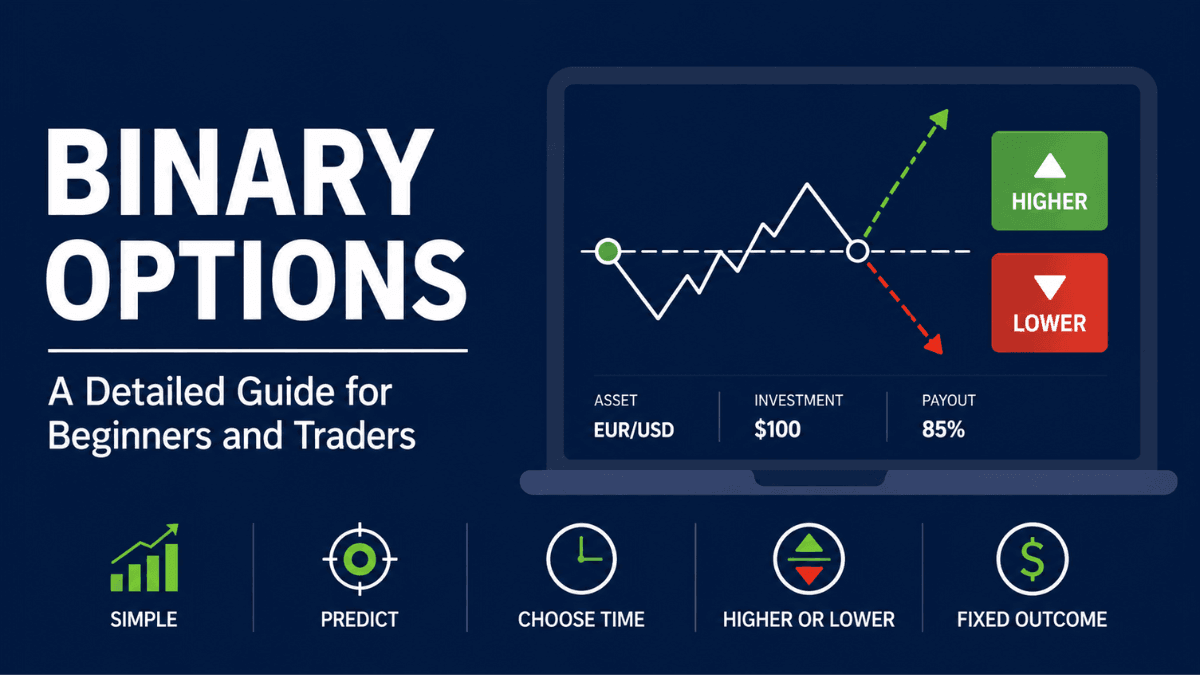
Binary Options are one of the simplest yet most controversial forms of financial trading. Unlike traditional trading, where profits and losses fluctuate with market movements, binary options have only two possible outcomes—you either receive a fixed payout or lose the amount you invested.
That simplicity has attracted millions of traders worldwide. At the same time, it has also attracted dishonest brokers, misleading marketing campaigns, and unrealistic promises of instant wealth. Understanding how binary options actually work is essential before risking any money.

This guide explains everything you need to know, from the basics to advanced concepts, including how binary options work, their advantages and disadvantages, common strategies, risk management, legal considerations, and whether this form of trading is right for you.
What Are Binary Options?
Binary Options are financial contracts where you predict whether the price of an asset will be above or below a specific price at a predetermined expiration time. The term “binary” refers to the fact that there are only two possible outcomes.
If your prediction is correct when the contract expires, you receive a fixed payout. If your prediction is incorrect, you lose your investment on that trade.
Unlike Forex or stock trading, you do not own the underlying asset. You are simply speculating on the direction of its price over a chosen period.
For example, suppose EUR/USD is trading at 1.1500.
You believe the price will rise over the next five minutes.
If you buy a “Higher” option and the price closes above 1.1500 after five minutes, your trade wins. If it closes below that level, your trade loses.
The size of the price movement usually doesn’t matter. A movement of one pip can produce the same outcome as a movement of one hundred pips.
How Binary Options Work
Understanding the mechanics of binary options helps explain both their appeal and their risks.
Every binary options trade contains several essential components.
The Asset
The asset is the financial instrument you’re trading.
Common assets include:
- Forex currency pairs
- Stocks
- Commodities
- Stock indices
- Cryptocurrencies (on some platforms)
Each asset has different levels of volatility and trading characteristics.
The Strike Price
The strike price is the market price when your trade begins.
Your prediction is measured against this price at expiration.
Expiration Time
Every trade has an expiration time.
This could range from seconds to several hours or even days, depending on the broker.
Popular expiration periods include:
- 30 seconds
- 1 minute
- 5 minutes
- 15 minutes
- 1 hour
- End of day
Shorter expiration times generally involve more market noise and randomness.
Investment Amount
This is the amount of money you risk on the trade.
Many platforms allow minimum investments as low as $1 or $5.
Fixed Payout
Before entering a trade, the broker displays the potential return.
For example:
Investment: $100
Payout: 85%
If you win:
- Profit = $85
- Total returned = $185
If you lose:
- Loss = $100
The payout percentage varies depending on the asset, market conditions, and broker.
Types of Binary Options
Not all binary options contracts are identical. Different types are designed for different trading objectives.
High/Low (Call/Put)
This is the most popular type.
You simply predict whether the market will finish above or below the strike price.
It is also the easiest format for beginners to understand.
One Touch
A One Touch option wins if the market reaches a predetermined price before expiration.
It doesn’t necessarily need to finish there.
These trades often offer higher payouts because the target price may be difficult to reach.
No Touch
The opposite of One Touch.
You predict that the price will not reach a specified level before expiration.
Range (Boundary)
You predict whether the asset’s price will remain inside or outside a predefined price range.
These contracts work well in either calm or highly volatile markets, depending on the setup.
Assets You Can Trade
Binary options platforms usually offer a wide range of markets.
Popular asset categories include:
- Major Forex pairs
- Technology stocks
- Energy commodities
- Precious metals
- Global stock indices
- Digital currencies
Each market behaves differently.
Forex often follows economic news.
Stocks react to company earnings.
Gold responds to economic uncertainty.
Understanding the characteristics of each asset can improve your decision-making.
Why Traders Choose Binary Options
The simplicity of binary options is one of their biggest attractions.
Instead of calculating stop-loss levels, take-profit targets, or position sizes, traders know both their maximum risk and potential reward before opening a trade.
Other advantages include:
- Simple trading process
- Small minimum deposits
- Fixed risk per trade
- Fast trade execution
- Available on desktop and mobile devices
- Wide range of tradable assets
Many beginners appreciate the straightforward structure.
Experienced traders often use binary options for short-term market opportunities.
The Risks of Binary Options
Despite their simplicity, binary options involve substantial risk.
Many new traders underestimate how difficult consistent profitability can be.
Several factors contribute to these risks.
High Loss Rate
A trader must maintain a relatively high win rate because payouts are usually smaller than losses.
For example:
If you risk $100 and earn only $80 when you win, you need to win well over half your trades just to break even.
Short Expiration Times
Very short expirations often resemble gambling more than investing.
Random market fluctuations can easily reverse a good trade before expiration.
Emotional Trading
Because trades finish quickly, emotions can escalate rapidly.
Winning streaks may create overconfidence.
Losing streaks may encourage revenge trading.
Both behaviors often damage long-term performance.
Fraudulent Brokers
Perhaps the greatest historical problem has been dishonest brokers.
Some platforms manipulated prices, delayed withdrawals, or simply disappeared with customer funds.
Although regulation has improved in many jurisdictions, traders should still conduct thorough research before opening an account.
Are Binary Options Gambling or Trading?
This question generates considerable debate.
The answer depends largely on how the trader approaches the market.
Someone who randomly clicks “Higher” or “Lower” without analysis is essentially gambling.
A trader who studies market trends, uses technical analysis, manages risk, and follows a structured trading plan is engaging in speculative financial trading.
Even then, binary options remain highly speculative because outcomes depend on short-term price movements.
Discipline—not the product itself—largely determines whether the activity resembles investing or gambling.
How Professional Traders Approach Binary Options
Experienced traders rarely rely on intuition.
Instead, they build structured systems based on probability.
Market Analysis
Professional traders study:
- Price trends
- Support and resistance levels
- Candlestick patterns
- Chart formations
- Momentum
- Market volatility
Every trade should have a logical reason behind it.
Economic Events
Major economic announcements can dramatically affect price movements.
Examples include:
- Central bank interest rate decisions
- Inflation reports
- Employment data
- GDP releases
- Company earnings
Many experienced traders avoid entering trades immediately before important news because volatility can become unpredictable.
Popular Binary Options Strategies
No strategy guarantees profits.
Successful traders focus on improving probabilities rather than seeking certainty.
Trend Following
Markets often continue moving in the same direction for a period.
Trend traders identify the dominant direction and trade with it rather than against it.
Support and Resistance
Support represents an area where buying pressure has previously appeared.
Resistance marks an area where selling pressure has historically increased.
These zones often provide high-probability trading opportunities.
Breakout Trading
Markets occasionally break through established price levels.
When confirmed by strong momentum, breakouts can produce significant moves before expiration.
Candlestick Confirmation
Individual candlesticks reveal buying and selling pressure.
Patterns such as engulfing candles, pin bars, and inside bars can improve trade timing when combined with other analysis.
Moving Average Strategy
Moving averages smooth price data and help identify trends.
Many traders combine two moving averages to generate entry signals.
Risk Management in Binary Options
Long-term success depends more on managing losses than maximizing wins.
Risk management protects your trading capital during inevitable losing periods.
Good habits include:
- Risk only 1–2% of your account per trade.
- Set daily loss limits.
- Avoid increasing position sizes after losses.
- Keep detailed trading records.
- Stop trading when emotions take control.
- Focus on consistency rather than excitement.
Even excellent traders experience losing streaks.
Capital preservation allows you to survive long enough to benefit from winning periods.
Common Mistakes Beginners Make
Most beginners lose money for predictable reasons rather than bad luck.
Recognizing these mistakes early can save both money and frustration.
Trading Without a Plan
Entering trades based on emotion usually produces inconsistent results.
A written trading plan provides consistency.
Chasing Losses
Trying to recover losses quickly often leads to even larger losses.
Successful traders accept losing trades as part of the business.
Ignoring Market Conditions
Strategies that work in trending markets may fail in sideways markets.
Learning to recognize market environments is an important skill.
Using Extremely Short Expiration Times
Thirty-second trades often contain too much random market noise.
Longer expiration periods generally provide more reliable price movement.
Believing Unrealistic Marketing
Social media often portrays binary options as effortless income.
Professional trading requires education, patience, and disciplined execution.
Choosing a Binary Options Broker
Not every broker deserves your trust.
Before opening an account, evaluate several important factors.
Look for:
- Transparent pricing
- Reliable withdrawals
- Responsive customer support
- Strong security measures
- Clear terms and conditions
- Demo account availability
- Educational resources
- Positive long-term reputation
Never choose a broker solely because it advertises unusually high payouts.
Trustworthiness matters far more than promotional offers.
Are Binary Options Legal?
The legal status of binary options varies significantly between countries.
Some jurisdictions allow regulated binary options trading.
Others restrict or prohibit it due to concerns about investor protection and fraud.
Before opening an account, you should verify the regulations that apply in your country and ensure any platform you use complies with local laws.
Using a properly regulated provider, where available, generally offers stronger consumer protections than trading with an unregulated offshore company.
Binary Options vs Forex Trading
Although both involve financial markets, they differ considerably.
| Feature | Binary Options | Forex Trading |
|---|---|---|
| Profit Potential | Fixed | Variable |
| Maximum Risk | Known before entry | Depends on stop-loss |
| Asset Ownership | No | No |
| Trade Duration | Fixed expiration | Flexible |
| Complexity | Lower | Higher |
| Risk Management Flexibility | Limited | Extensive |
Forex provides greater flexibility and professional tools.
Binary options offer greater simplicity but less control over trade management.
Can You Make Money with Binary Options?
Yes, it is possible to make money with binary options.
The more important question is whether you can do so consistently over the long term.
That requires:
- A proven trading strategy
- Effective risk management
- Emotional discipline
- Continuous learning
- Realistic expectations
Most successful traders spend months practicing before risking significant amounts of money.
Anyone promising guaranteed profits should be treated with skepticism.
Is Binary Options Trading Suitable for Beginners?
Binary options can be easy to understand, but that doesn’t automatically make them easy to trade.
Beginners should start by learning how financial markets behave rather than focusing only on placing trades.
Practicing with a demo account, studying technical analysis, and keeping a trading journal can build valuable experience without exposing real money to unnecessary risk.
Patience is often a greater advantage than speed.
Frequently Asked Questions About Binary Options
Are binary options safe?
Binary options themselves are financial instruments, but safety depends largely on the platform you use. Choosing a reputable, transparent, and regulated provider where available reduces many of the risks associated with fraudulent operators.
Can beginners trade binary options?
Yes, beginners can learn binary options because the mechanics are relatively straightforward. That said, understanding market analysis and risk management is still essential before trading with real funds.
How much money do I need to start?
Many platforms allow accounts to be opened with small deposits, sometimes as little as $10 or less. Starting small while you gain experience is generally a more sensible approach than committing large sums.
Can I lose all my money?
Yes. Every trade risks the amount you invest, and repeated losses can deplete your trading account. Using strict position sizing and daily loss limits helps manage this risk.
Is binary options trading better than Forex?
Neither is inherently better. Binary options are simpler but offer less flexibility, while Forex trading provides more advanced tools and trade management options. The better choice depends on your goals, experience, and risk tolerance.
Final Thoughts
Binary Options offer a straightforward way to speculate on short-term price movements, but their simplicity should not be mistaken for low risk. Every trade presents an all-or-nothing outcome, making education, discipline, and sound risk management critical for long-term success.
If you decide to explore binary options, begin with a demo account, develop a tested trading strategy, and approach every trade with realistic expectations. Avoid platforms that promise guaranteed profits or pressure you into depositing more money. Consistent traders focus on managing risk, improving their decision-making, and treating trading as a skill that develops over time—not as a shortcut to quick wealth.
Trade Anytime, Anywhere with XM
Take your trading to the next level with a globally trusted forex and CFD broker. Enjoy competitive spreads, fast execution, and reliable customer support while trading securely.
With XM, you get access to powerful trading platforms, real-time charts, flexible account types, and advanced tools to help you analyze the markets and manage your trades efficiently. Start your journey today by opening a trading account for free and join millions of traders worldwide.
✅ Open an Account with XM
Our Editorial Desk – Focuses on forex trading, gold (XAU/USD), and commodities that move the markets. Our editorial desk blends human insight with AI-powered research to produce sharp, actionable content. We aim to help traders make informed decisions with unbiased market coverage.